

Losing fat without losing muscle boils down to sending your body two very distinct signals. First, you need a reason to burn body fat for fuel, which comes from a moderate, intelligent calorie deficit. Second, you absolutely must give your body a compelling reason to keep its muscle, and that signal comes from progressive resistance training.
When you nail these two principles and support them with sufficient protein and smart recovery, you create the optimal environment for your body to shed fat while holding onto your hard-earned strength. As coaches, this is the exact system we use to get sustainable results for our clients.
The Real Reason You Lose Muscle While Dieting
The number one fear I hear from new clients is that all their hard work in the gym will vanish the second they start a fat-loss phase. The good news? It absolutely doesn't have to. The typical "diet and cardio" approach is fundamentally flawed because it fails to give your body a powerful reason to hold onto metabolically active muscle tissue.
When you just slash calories and ramp up cardio without lifting heavy, your body goes into survival mode. It sees muscle as metabolically expensive to maintain and views your body fat as precious stored energy. Without the stimulus of resistance training, your body has zero incentive to preserve muscle and will happily break it down for fuel. In practice, this is the single biggest mistake we see people make over and over again.
Why Your Body Sacrifices Muscle First
During a typical, poorly planned diet, roughly 20-30% of the total weight you lose can come from lean tissue—that's your muscle, not just fat. Studies have shown that people on calorie-restricted diets who don't do resistance training can lose about 25% of their weight from lean muscle. This tanks their resting metabolic rate by up to 15%, making future fat loss harder and sabotaging their strength.
For anyone who wants to look lean, strong, and athletic, this is a disastrous outcome. A slower metabolism means you have to eat even less just to keep the scale moving, locking you into a vicious cycle of frustration.
The goal isn't just weight loss; it's body recomposition. We want to change the ratio of fat to muscle, and that requires a much smarter strategy than simply "eating less and moving more."
Here at our Toronto gym, we teach clients that a deliberate, intelligent strategy is what allows them to shed fat while keeping their strength. Our entire method is built on three core pillars that work in sync:
- Calculated Nutrition: Understanding the difference between calories and macros is crucial for fuelling your body correctly. We focus on a precise energy deficit, not starvation.
- Progressive Resistance Training: This is your non-negotiable. It’s the signal that tells your body muscle is essential and must be preserved at all costs.
- Strategic Recovery: Sleep and stress management are when your body actually repairs and rebuilds itself, locking in your progress.
This is the exact, science-backed system we use with busy professionals who need an efficient approach that flat-out delivers results.
Your Nutrition Blueprint for Sparing Muscle
Forget vague advice like “eat clean.” To lose fat without sacrificing muscle, your nutrition must be strategic. This isn’t about starving yourself; it’s about giving your body exactly what it needs to burn fat while sending a strong signal to hold onto your hard-earned muscle. In practice, this boils down to mastering two things: a sensible calorie deficit and a non-negotiable protein target.
Setting a Sustainable Calorie Deficit
Every fat loss plan starts with a calorie deficit—eating fewer calories than your body burns. But how you create that deficit is what separates a successful cut from a muscle-wasting disaster.
With most clients, we start with a moderate, sustainable deficit—usually 300-500 calories below their daily maintenance needs. This is the sweet spot. It’s enough to trigger consistent fat loss of about 0.5-1% of body weight per week, but not so aggressive that your body panics and starts burning muscle for fuel.
Aggressive crash diets are the fastest way to kill your strength, wreck your metabolism, and feel miserable. This approach simply doesn't work for anyone who cares about their performance in the gym. The trade-off for faster weight loss is always more muscle loss, which is a price you don't want to pay.
The Non-Negotiable Role of Protein
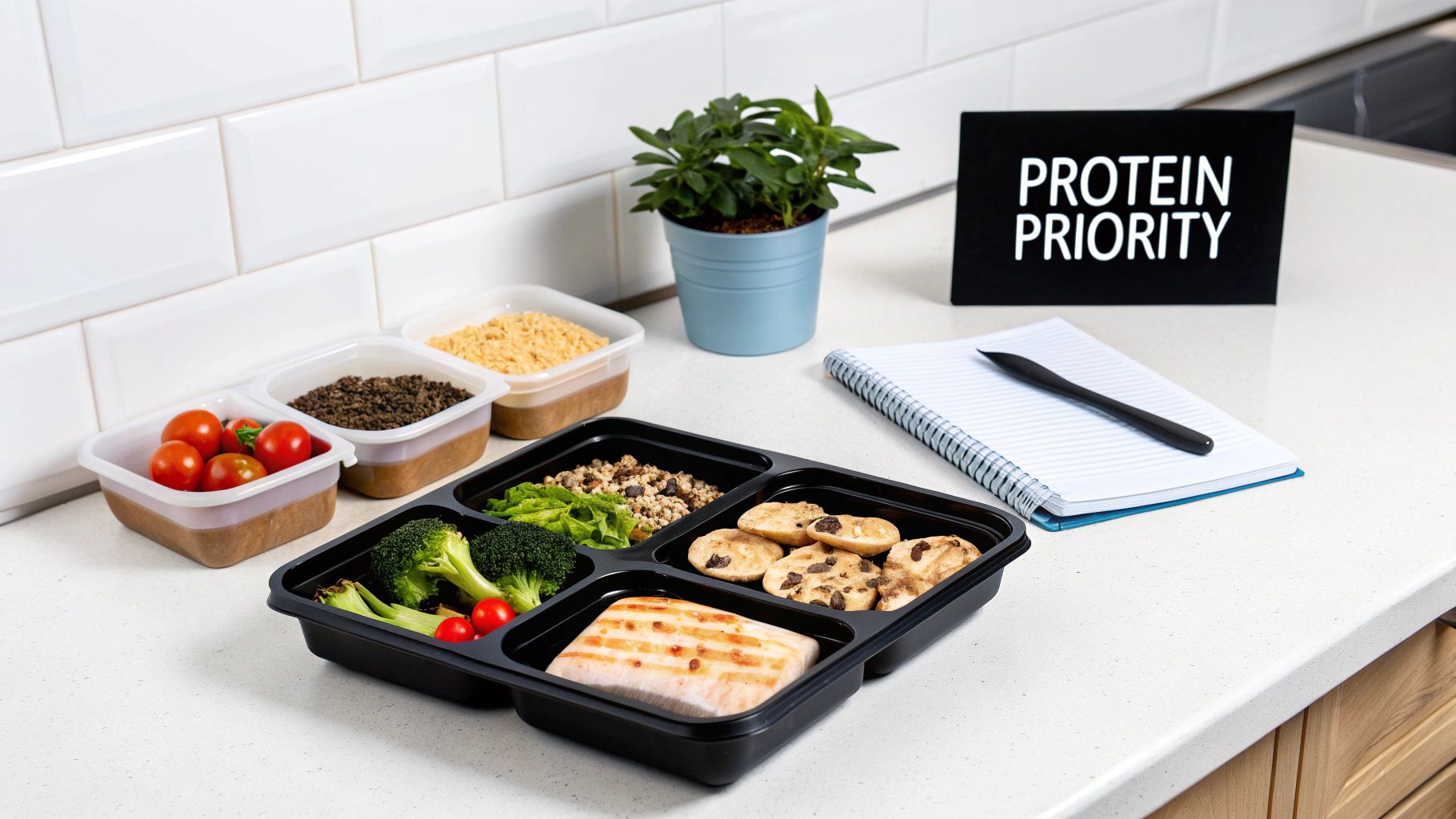
If the calorie deficit is the general instruction, protein is the specific command. Protein is the most critical macronutrient for preserving muscle. It provides the amino acids needed to repair and maintain tissue, especially when calories are lower. Plus, it has the highest thermic effect (your body burns more calories digesting it) and keeps you feeling full, making adherence much easier.
For anyone serious about this goal, we set a clear, non-negotiable protein target: 1.6 to 2.2 grams of protein per kilogram of body weight.
Let's make that practical:
- For a 200 lb (91 kg) person, that’s about 145-200 grams of protein per day.
- For a 150 lb (68 kg) person, you’re looking at 110-150 grams of protein daily.
Hitting this number is everything. If you find that challenging, our guide on how to optimize your protein intake for better results has a ton of practical tips. Think of this as the foundation of your entire fat loss phase.
Coaching Insight: We tell clients to treat their protein target as their number one priority each day. Calories can fluctuate slightly, but that protein number needs to be hit consistently. This one shift in mindset makes a huge difference in holding onto muscle.
Don't Fear Carbs and Fats
A classic mistake is slashing carbs and fats to the bone, hoping to speed up fat loss. It always backfires. Carbohydrates are your primary fuel for tough workouts, and healthy fats are crucial for regulating hormones like testosterone—a key player in muscle maintenance.
Once your protein target is set, carbs and fats make up the rest of your daily calories. We typically have clients place most of their carbs around their workouts to fuel performance and kickstart recovery. Healthy fats from sources like avocado, nuts, and olive oil can then fill out other meals to support overall health. This balanced approach works wonders for almost everyone who wants to feel good and perform well.
A very low-carb approach only works for a tiny fraction of people, like competitive physique athletes in the final weeks of prep—and even then, it's a short-term tool, not a sustainable lifestyle. For the rest of us, carbs are an essential tool for performance.
Sample Daily Macronutrient Targets for Fat Loss
To bring this all together, here’s what these targets might look like for a couple of hypothetical clients. Remember, these are just starting points; we’d fine-tune these numbers based on a client's unique InBody scan, activity level, and weekly progress.
| Client Profile | Target Daily Calories | Protein (g) | Carbohydrates (g) | Fats (g) |
|---|---|---|---|---|
| Male, 40, 200 lbs, moderately active | 2,200 kcal | 180 | 205 | 71 |
| Female, 35, 150 lbs, moderately active | 1,700 kcal | 130 | 165 | 58 |
Your nutrition plan is the blueprint. By combining a smart calorie deficit with high protein and adequate carbs and fats, you create the perfect environment to lose fat while keeping your muscle. The next step is to pair this blueprint with the powerful stimulus of resistance training.
The Cornerstone Of Your Plan: Progressive Resistance Training
If nutrition is the blueprint, resistance training is the crew that protects your muscle. When shedding fat, lifting weights isn't just a good idea—it's non-negotiable. It is the single most powerful signal you can send your body to hold onto lean muscle while in a calorie deficit.
Without that signal, your body has no reason to keep metabolically expensive muscle tissue. Lifting essentially tells your body, "Hey, we need this stuff! This muscle is critical for survival." That stimulus forces it to tap into stored body fat for energy instead of breaking down your hard-earned gains.
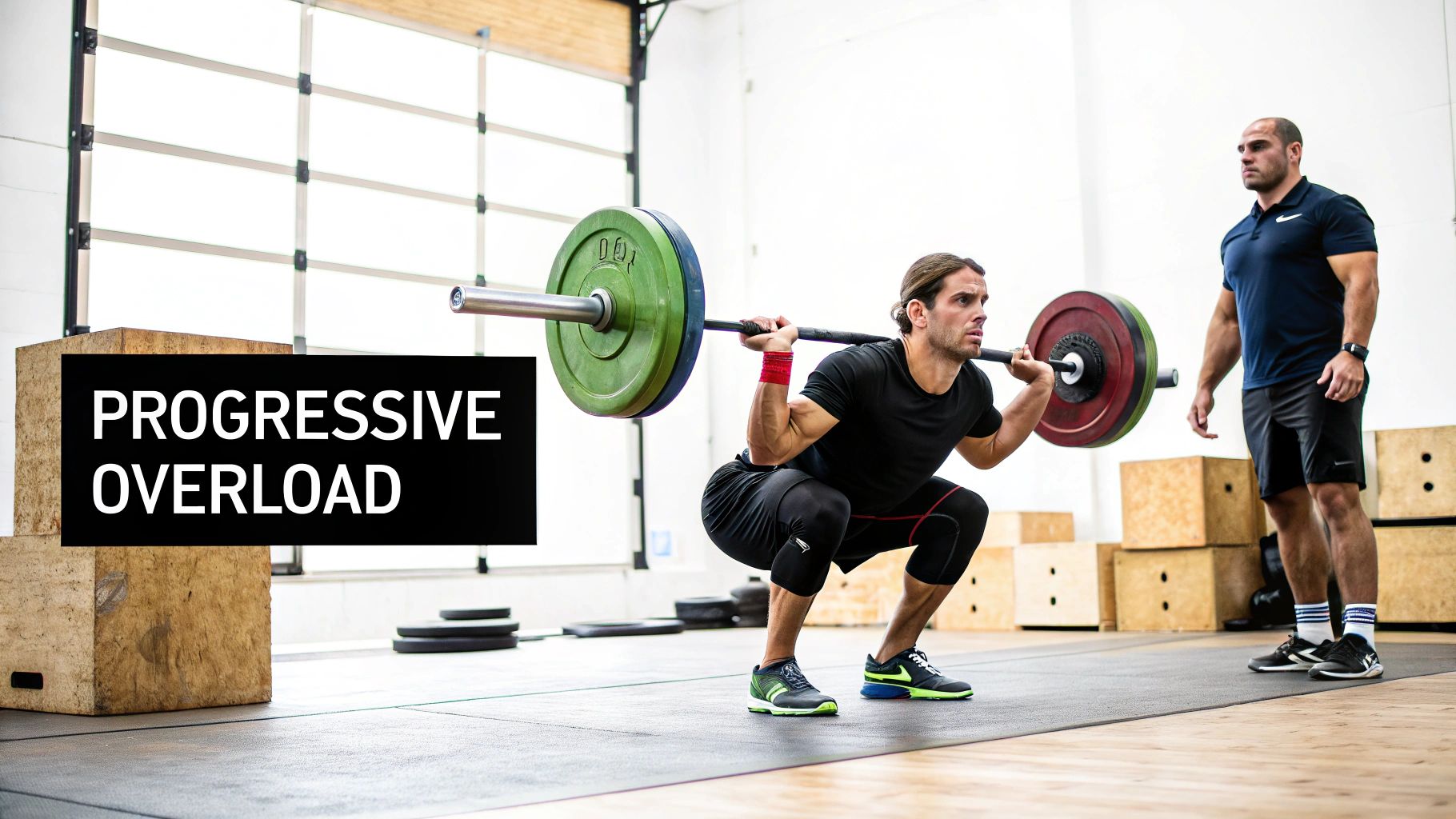
The difference is night and day. Studies show that a weight loss of 8-10% from diet alone can strip away 2-10% of your muscle mass. But what happens when you add resistance training? You can almost completely stop that muscle loss.
Research has found that adults who only dieted lost 9% of their body weight, but also lost 6% of their muscle. In contrast, a similar group that added just three weight training sessions per week preserved 85-95% of their lean mass and got stronger while dropping fat.
Embracing Progressive Overload
Your main goal in the gym during a fat loss phase isn't to burn calories. It’s to maintain—or even increase—your strength. The key to this is a principle called progressive overload.
It’s a straightforward concept: you must consistently challenge your muscles to do more work than they're used to. This is the foundation of progressive resistance training and the trigger for muscle preservation.
Here’s how we put this into practice with clients:
- Add More Weight: The most direct route. If you squatted 150 lbs for 8 reps last week, aim for 155 lbs for 8 reps this week.
- Do More Reps: Can't add weight yet? Push for more repetitions with the same weight. Benching 135 lbs for 8 reps is a clear win over doing it for 7.
- Increase The Volume: Adding an extra set to an exercise is another way to increase the total workload and tell your muscles to stick around.
- Perfect Your Form: Lifting the same weight with better control and a fuller range of motion is a huge form of progression that improves muscle activation.
This method works for anyone serious about changing their body composition. It's not a quick fix, and it won't work for people who aren't willing to put in focused, consistent effort.
Build Your Training Around Compound Lifts
To get the most bang for your buck, especially for busy professionals, we center programs around big, multi-joint compound movements. These are the exercises that hit multiple muscle groups at once, delivering a powerful hormonal and metabolic response that's perfect for preserving muscle.
We always prioritize movements like:
- Squats
- Deadlifts
- Bench Presses
- Overhead Presses
- Rows
- Pull-Ups
For hypertrophy (the technical term for muscle growth and maintenance), the 6-12 rep range is king. It hits the sweet spot of mechanical tension and metabolic stress needed to signal muscle preservation. While lifting super heavy for low reps is fantastic for pure strength, this moderate range is where the magic happens for body composition. For a deeper look, check out our guide on what you need to know about rep ranges.
Coaching Insight: A common mistake we see is people starting a fat loss phase and immediately switching to high-rep, low-weight "toning" workouts. This is one of the worst things you can do. Light weights don't provide a strong enough stimulus to convince your body to hold onto muscle. You have to maintain your training intensity.
Sample Training Splits for Busy Professionals
You don't need to live in the gym to get results. Quality and consistency always beat quantity. For most clients, a 3 or 4-day full-body or upper/lower split is the most effective and sustainable approach.
3-Day Full-Body Split Example:
- Day 1: Squat variation, Bench Press, Barbell Row, Face Pulls, Core Work
- Day 2: Rest or Active Recovery
- Day 3: Deadlift variation, Overhead Press, Pull-Ups or Lat Pulldowns, Leg Press, Core Work
- Day 4: Rest or Active Recovery
- Day 5: Lunge variation, Dumbbell Incline Press, Seated Cable Row, Lateral Raises, Core Work
- Day 6 & 7: Rest or Active Recovery
4-Day Upper/Lower Split Example:
- Day 1: Upper Body (Pushing Focus)
- Day 2: Lower Body (Squat Focus)
- Day 3: Rest
- Day 4: Upper Body (Pulling Focus)
- Day 5: Lower Body (Hinge/Deadlift Focus)
- Day 6 & 7: Rest
This structure ensures you're hitting every major muscle group with enough frequency and intensity to prevent muscle loss. Your final, non-negotiable step? Track your workouts. Write down your exercises, weights, sets, and reps every single time. That data is the only way to know you're making progress.
Using Cardio as a Strategic Tool, Not a Punishment
It’s time to reframe how you think about cardio. A huge mindset shift I work on with new clients is moving away from the idea that cardio is punishment for what they ate or the main driver of fat loss. It’s neither.
Think of cardio as a strategic tool. You use it intelligently to create a larger energy deficit without having to slash your food intake to unsustainable levels.
Over-relying on cardio while your strength training takes a backseat is one of the most common mistakes. Endless, grueling cardio sessions place a massive recovery demand on your body. Remember, in a calorie deficit, your body has limited resources to repair itself. Pushing cardio too hard can directly interfere with your ability to recover from strength training, compromise gym performance, and even signal your body to shed precious muscle.
Finding the Cardio Sweet Spot
The goal is the minimum effective dose. We want just enough cardio to support fat loss, not the absolute maximum you can tolerate.
For the vast majority of our clients, this looks like two to three sessions per week, for 20-30 minutes each. That’s more than enough to widen your calorie deficit without sabotaging your recovery and muscle-preservation efforts.
We strategically program different types of cardio, factoring in the client's goals, recovery ability, and what their schedule allows.
- Low-Intensity Steady State (LISS): This is our go-to for most people. Think of a brisk walk on an incline treadmill or a steady pace on an elliptical. LISS is fantastic because it has a very low impact on recovery, meaning it won't interfere with your strength workouts.
- High-Intensity Interval Training (HIIT): This involves short, all-out bursts of effort followed by brief recovery periods, like 30 seconds of sprinting on an assault bike followed by 60 seconds of easy pedaling. HIIT is incredibly time-efficient and great for cardiovascular fitness.
Who Is HIIT For and Who Should Avoid It?
HIIT works best for intermediate-to-advanced clients who are short on time and have a solid recovery foundation (good sleep, low stress). It's highly effective, but it’s also very demanding on your central nervous system.
HIIT is NOT a good fit for beginners, anyone dealing with high stress, or those already struggling with recovery. For these clients, adding intense HIIT is like pouring gasoline on a fire—it just leads to burnout and potential muscle loss. For them, LISS is the far smarter choice.
The Key Takeaway: Your strength training protects muscle, and your nutrition drives fat loss. Cardio is simply a supporting tool to help create your deficit.
Treat cardio as a supplement to your lifting, never a replacement for it. Prioritize getting stronger, nail your protein target daily, and then sprinkle in short, strategic cardio sessions to accelerate fat loss without undermining your hard work.
Why Recovery and Sleep Are Non-Negotiable
Training hard and eating right are just signals you send your body. The real change—the fat loss and muscle retention—happens when you rest. We see it all the time: clients who crush their workouts and stick to their nutrition, only to hit a wall because they treat recovery as an optional extra.
It’s a massive mistake.
Recovery isn’t just taking days off. It's an active process where your body repairs muscle tissue and balances the hormones that control your results. Skimp on it, and you're just spinning your wheels.
Sleep Is When the Real Magic Happens
Your single most powerful recovery tool is sleep. It's not passive downtime; it’s when your body ramps up production of growth hormone, repairs damaged muscle fibers, and manages cortisol—the stress hormone that, when unchecked, tells your body to break down muscle and store fat.
This is why we make 7-9 hours of quality sleep per night a non-negotiable part of any client's program.
That number isn't arbitrary. Consistently getting less than that actively works against everything else you're doing. A sleep-deprived body is a stressed body, far more likely to shed muscle and cling to stubborn fat.
Coaching Insight: I had a client who was doing everything by the book—training with intensity, hitting his protein goals—but his progress photos and InBody scans showed he was losing muscle. The culprit? His high-pressure job had him averaging five hours of sleep a night. Once we implemented a strict sleep hygiene routine, his body composition started turning around in less than two weeks.
Cutting Through the Supplement Noise
The supplement industry is noisy, but our philosophy is simple: master the fundamentals first, then add only what's proven to give you a real edge. For losing fat without losing muscle, you only need to consider a few key players.
The Essentials We Recommend:
- Creatine Monohydrate: One of the most studied supplements on the planet. It's proven to help maintain strength and performance, which is critical for training hard in a calorie deficit.
- Protein Powder: A convenience tool. It's not magic, but it makes hitting your daily protein target much easier, especially for busy professionals.
- Vitamin D: For anyone living in Canada, particularly during darker months, Vitamin D is often necessary for supporting overall health and hormone function.
That’s it. These three work, are safe, and deliver a genuine return on investment. On the flip side, we tell clients to save their money on gimmicks like "fat burners," which are typically loaded with stimulants and offer little real-world benefit for sustainable fat loss.
The science behind combining smart training with your diet is clear. For example, one study showed that while dieting alone caused about 25% of weight loss to come from lean muscle, adding resistance and endurance training dropped that number to just 17%. That's a huge difference in protecting your metabolism. You can read up on the powerful effects of combining exercise and diet for muscle preservation.
Ultimately, your results are dictated by how well you recover. If you want to dive deeper, check out our guide on the four pillars of strength training recovery.
Treat sleep with the same importance as your workouts and nutrition. Plan for it, build a relaxing wind-down routine, and turn your bedroom into a sanctuary for rest. This one habit is the ultimate force multiplier for your results.
Tracking Progress Beyond the Scale
There's an old coaching maxim: what gets measured gets managed. But when your goal is to lose fat while keeping muscle, the bathroom scale tells you a tiny, often misleading, part of the story.
Your body weight is a fickle number. It can swing based on last night's dinner, water retention, or hormonal shifts. The scale can't distinguish between fat, muscle, and water, which is why relying on it alone is an incredibly frustrating ride.
To know if you're winning, you need better data—the kind that gives you real insight into what's happening with your body composition.
Adopting a Data-Driven Approach
At our gym, we use professional tools to get a precise picture of our clients' progress. You can learn more about how an InBody scan tracks your progress by breaking down your exact muscle mass and body fat percentage. Understanding your body composition is a game-changer, and various body composition analysis tools paint a much clearer picture than total weight ever could.
That said, you don’t need a lab to see what’s really going on. We teach our clients to use a simple, multi-faceted approach that gives them the complete story.
Coaching Insight: Think of it like collecting evidence. If the evidence points in the right direction, you keep going. If it doesn't, you make one small, smart adjustment. This data-first mindset takes the emotion out of the process.
Your Real-World Progress Dashboard
To get a true read on your progress, combine three simple but powerful metrics:
- Progress Photos: Snap pictures from the front, side, and back every two to four weeks. Consistency is key—same lighting, location, and time of day. Photos don't lie and often show changes in muscle definition the scale completely misses.
- Key Body Measurements: Once a month, use a flexible measuring tape to track your waist (at the belly button), hips, and thighs. A shrinking waist is one of the best indicators of fat loss, even if your weight hasn't budged.
- Gym Performance: Are you getting stronger? Can you lift more weight or do more reps than last month? If your strength is going up—or even just holding steady—that's a huge sign you're successfully preserving muscle.
This simple decision tree highlights how crucial recovery is to your ability to perform and, ultimately, hold onto muscle.
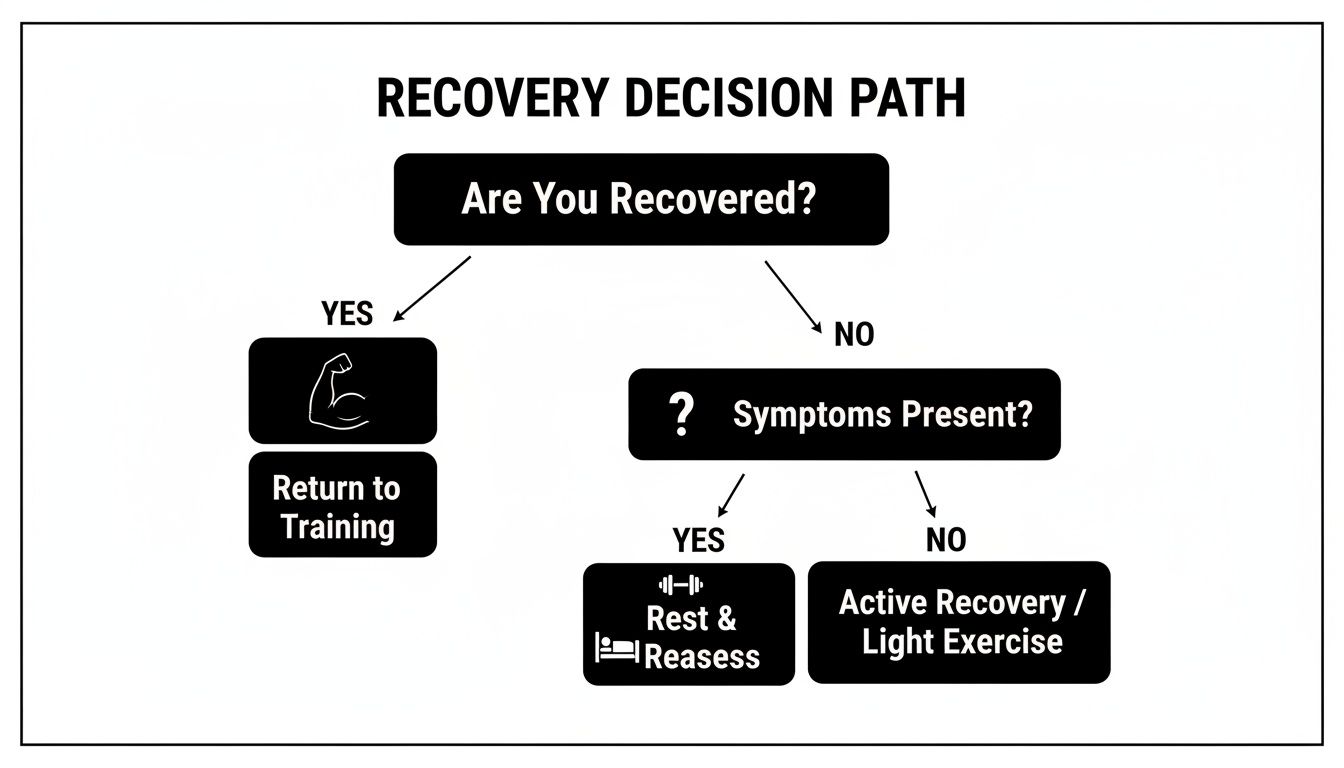
As you can see, checking in with your recovery status is a non-negotiable step before any effective training session.
Here’s the scenario we love to see: the scale has barely moved in two weeks, but your waist is down half an inch, your photos look leaner, and you just hit a new personal best on your squat. That’s not a plateau; that is a huge win. It’s proof you’re successfully recomping—trading fat for muscle.
Your next step is to set up a simple system to track these numbers. A notebook or a basic spreadsheet will do. This personal dashboard will become your most trusted guide, allowing you to make smart decisions based on real data, not the random whims of the scale.
Burning Questions About Fat Loss and Muscle
As coaches, we get the same questions about losing fat without sacrificing muscle. Let's cut through the noise and give you straight answers to the most common ones we hear on the gym floor.
Can I Build Muscle and Lose Fat at the Same Time?
Yes, but this process, called body recomposition, works best for specific groups.
We typically see it in:
- New Lifters: If you're new to strength training and have a higher body fat percentage, your body is primed to respond. It's a sweet spot where you can build muscle and burn fat quite effectively.
- Returning After a Break: Anyone who's taken significant time off often gets a boost from "muscle memory," allowing them to regain lost muscle even while dieting.
- Using Performance-Enhancing Drugs: It's important to be realistic. Anabolic steroids change the game entirely, making it much easier to build muscle in a calorie deficit.
For seasoned, natural lifters, trying to build significant new muscle while cutting calories is a tough, often fruitless battle. For you, the focus should shift squarely to muscle preservation. Hold onto what you've built while the fat comes off.
How Fast Can I Safely Lose Fat Without Losing Muscle?
Patience is your best friend. The ideal rate we aim for with clients is a weekly weight loss of 0.5% to 1.0% of your total body weight.
Pushing faster requires a calorie deficit so steep that your body starts breaking down muscle for energy. For a 200 lb person, that’s a target of 1-2 lbs lost per week. It might not sound dramatic, but it’s the pace that ensures you're losing primarily fat, not muscle, and keeping your strength up in the gym.
Will Lifting Lighter Weights for More Reps Help Me "Tone Up"?
This is one of the biggest myths in fitness. The "toned" look comes from one thing: having visible muscle definition because your body fat is low enough to see it.
Switching to light weights for endless reps is counterproductive. It signals to your body that the heavy-duty strength it built is no longer required, giving it the green light to let that muscle go.
If you want to keep your muscle, you have to give your body a reason to. Keep lifting heavy and challenging yourself with progressive overload. Your nutrition is the tool for fat loss; the gym is the tool for muscle retention.
The key takeaway is this: to lose fat and keep muscle, you must lift heavy, eat enough protein, maintain a moderate calorie deficit, and prioritize sleep. Your next step is to choose one area—nutrition, training, or recovery—and commit to improving it for the next two weeks. Focus on consistent action, not perfection.
Ready to stop guessing and start seeing real, measurable results? The expert coaches at OBF Gyms build personalized training and nutrition plans that help busy Toronto professionals lose fat and build strength—guaranteed. Book a consultation today to learn how our proven method can transform your body.
 The 3 training mistakes