

Meal prepping for weight loss can feel overwhelming, packed with complex recipes and conflicting advice. This guide cuts through that noise. We're not just listing bland chicken and broccoli recipes; we're giving you eight proven, coach-approved meal prep systems designed for busy people who need a practical plan for fat loss.
Each of these meal prep ideas for weight loss is a template you can start using this week. You'll learn exactly how to align your food with your workouts, manage hunger, and build habits that stick. Forget generic advice. This is the actionable blueprint you need to finally see the results you've been working for.
1. The 40/30/30 Macro-Balanced Bowl Template
The 40/30/30 macro-balanced bowl isn't a single recipe—it's a powerful blueprint for creating satisfying meals that fuel fat loss while preserving muscle. This approach structures your meals with a specific macronutrient ratio: 40% carbohydrates, 30% protein, and 30% fat. This balance helps regulate blood sugar, gives you sustained energy, and keeps you feeling full.
This template ensures every meal is nutritionally complete. By combining a lean protein, a complex carbohydrate, a healthy fat, and fibrous vegetables, you create a portion-controlled meal that supports your training schedule and takes the guesswork out of hitting your targets.
How to Build Your Bowl
Follow this simple structure to create endless variations:
- Protein (30%): Start with a lean protein source. Good options include grilled chicken breast (130g), a salmon fillet (120g), or lean ground turkey (140g).
- Carbohydrates (40%): Choose complex carbs for slow-releasing energy, like jasmine rice (150g), roasted sweet potato (180g), or quinoa (120g).
- Fats (30%): Add a healthy fat for hormone production and nutrient absorption. This could be a drizzle of olive oil (1 tbsp), ¼ of an avocado, or 1 tbsp of almond butter in a sauce.
- Vegetables: Fill the rest of your container with non-starchy vegetables like roasted broccoli, steamed asparagus, or mixed greens for fibre and micronutrients.
Actionable Tip
To master this, a basic understanding macros for weight loss is helpful. On Sunday, prep your proteins and carbs in separate batches. For example, grill all your chicken and roast all your sweet potatoes. Then, you can assemble your bowls daily to keep ingredients fresh and prevent them from getting soggy.
2. High-Protein Low-Carb Day / High-Carb Training Day Protocol
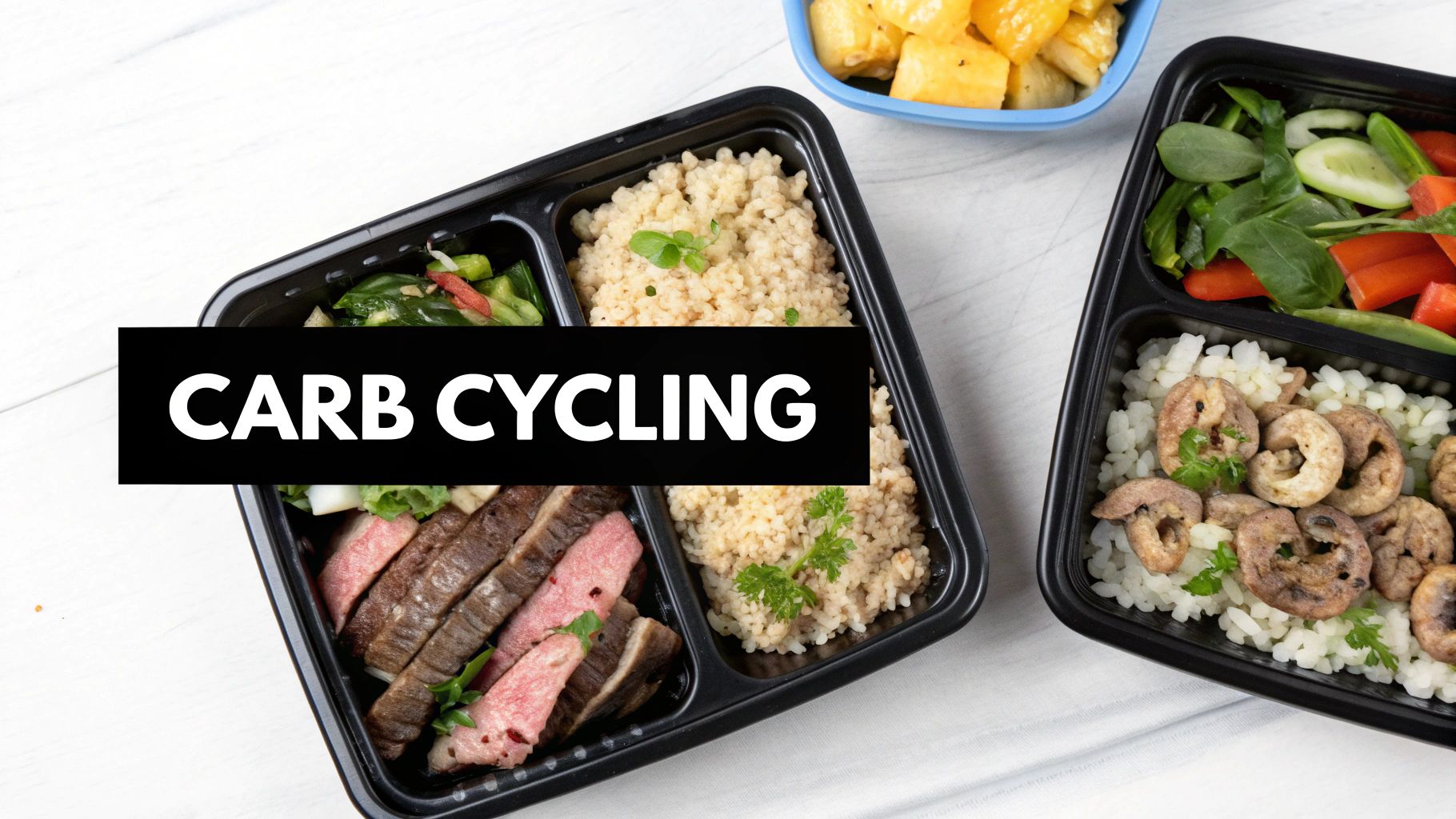
This strategy, often called carb cycling, matches your nutrition directly to your training demands. It involves alternating your macronutrient intake based on your activity level, which helps optimize energy use—providing fuel when you need it most and promoting fat burning when you don't.
On heavy strength training days, you'll eat more carbohydrates to fuel performance and replenish muscle glycogen. On rest days or low-intensity days, you'll reduce carbs and increase protein to preserve muscle while staying in a calorie deficit. This intelligent alignment can accelerate fat loss without hurting your gym performance.
How to Structure Your Days
Here's a simple template to align your food with your workouts:
- High-Carb Training Day (approx. 45% Carbs / 30% Protein / 25% Fat): Fuel your body for maximum effort. A meal might look like 170g steak with 200g white rice, spinach, and a small amount of butter.
- Low-Carb Rest Day (approx. 25% Carbs / 35% Protein / 40% Fat): Prioritize protein for muscle repair and healthy fats for satiety. An example meal is 150g ground beef with 250g cauliflower rice, broccoli, and coconut oil.
Actionable Tip
Prep all your proteins (like chicken or beef) and carb sources (like rice and sweet potatoes) in separate bulk batches. This allows you to assemble the right macro-specific meal each day. To make it foolproof, use color-coded containers—for instance, red for high-carb days and blue for low-carb days—to grab and go without thinking.
3. The Protein-First Satiety Model (High-Protein, Moderate Everything Else)
The Protein-First model prioritizes protein to maximize fullness and preserve muscle during a calorie deficit. This framework typically allocates 35-40% of daily calories to protein, with the rest split between moderate carbohydrates and fats. By putting protein first, you directly combat hunger, which is often the biggest obstacle to weight loss.
This model is highly effective because protein has the highest thermic effect of food (TEF), meaning your body burns more calories digesting it. A high-protein diet is also crucial for preserving lean muscle mass as you lose fat, which helps keep your metabolism from slowing down. It makes being in a calorie deficit feel much more manageable.
How to Build Your Plate
Use this protein-centric structure for your meals:
- Protein (35-40%): Build your meal around a significant protein source, aiming for 30-40g per meal. Examples include a large chicken breast (200g), lean ground beef (180g), or a salmon fillet (150g).
- Carbohydrates (35-40%): Add a moderate portion of complex carbs for energy, like brown rice (120g) or sweet potato (130g).
- Fats (20-25%): Include a small amount of healthy fats, such as 1/2 an avocado or a teaspoon of olive oil.
- Vegetables: Fill the rest of your plate with fibrous vegetables like broccoli, roasted Brussels sprouts, or mixed greens to boost satiety and nutrient intake.
Actionable Tip
A good rule of thumb for your daily protein target is 0.8-1.0 grams per pound of your ideal body weight. Spread this target evenly across 4-5 meals. To make this approach budget-friendly, use affordable sources like eggs, canned tuna, Greek yogurt, and ground turkey.
4. The Slow-Carb Intermittent Fasting (SCIF) Meal Prep System
The SCIF system combines two powerful strategies: intermittent fasting (IF) and slow-carb eating. This approach involves eating all your daily calories within a specific window (typically 6-8 hours) and focusing on meals built around low-glycemic carbohydrates. This combination promotes satiety, stabilizes blood sugar, and improves insulin sensitivity, making it easier to manage hunger during fasting periods.
With SCIF, you use fasting to tap into fat stores for energy, then break your fast with slow-digesting carbs to prevent energy crashes. By prepping meals rich in protein, fibre, and complex carbs, you ensure your eating window provides sustained nourishment that carries you through to the next one.
How to Build Your SCIF Plan
Here is a sample structure for planning your meals within a fasting window:
- Fasting Window: A common starting point is a 16:8 schedule, where you fast for 16 hours and eat within an 8-hour window (e.g., 12 p.m. to 8 p.m.).
- Meal 1 (Breaking the Fast): Focus on a large, balanced meal like a big lentil and chicken bowl with mixed greens. The high protein and fibre will kickstart satiety.
- Meal 2 (Final Meal): Your second meal should also be substantial to prepare your body for the fast. A salmon fillet with roasted sweet potato and asparagus is a great choice.
- Carbohydrates: Prioritize slow-digesting sources like legumes (lentils, chickpeas), sweet potatoes, and rolled oats.
- Protein: Aim for at least 25-30 grams of protein per meal to preserve lean muscle.
Actionable Tip
Try to schedule your strength training one to two hours before your eating window begins. This timing helps direct nutrients toward muscle repair and recovery. If you're new to fasting, start with a shorter 14-hour fast and gradually extend it as your body adapts. Remember to stay hydrated with water, black coffee, or tea during your fast.
5. The Reverse Diet Meal Prep (Progressive Calorie/Macro Increase Protocol)
Reverse dieting is a strategic protocol used after a fat loss phase to methodically increase calories while maintaining your new, leaner physique. Instead of jumping back to old habits, you gradually reintroduce calories—primarily from carbs—to boost your metabolism and prevent rebound weight gain.
This protocol works by slowly adding 50-75 calories per week over an 8-12 week period. This measured increase helps your body adapt, restoring hormones and replenishing glycogen without triggering rapid fat storage. It essentially rebuilds your maintenance calories to a higher, more sustainable level.
How to Build Your Reverse Diet Plan
Start from your final fat loss calorie target and add small increments weekly.
- Establish a Base Meal: Create a simple, repeatable meal as your foundation. For example: 150g grilled chicken breast, 80g jasmine rice, and steamed broccoli.
- Add Carbohydrates First: For the first few weeks, focus the increase on complex carbs. Using the base meal, your progression might look like this:
- Week 1: Base meal + 50g cooked rice
- Week 2: Base meal + 100g cooked rice
- Week 3: Base meal + 150g cooked rice
- Introduce Healthy Fats Later: Once your carb intake is higher, you can start adding healthy fats, like ¼ avocado.
- Monitor and Adjust: Track your weight, measurements, and performance. The goal is a slow, controlled increase in weight, primarily from muscle and glycogen.
Actionable Tip
Prep your base meal in bulk and portion out the weekly incremental additions into separate small containers. This makes it easy to add the correct amount each day without guesswork. A key sign of a successful reverse diet is improved strength in the gym; aim for a 5-10% increase in your main lifts as your energy levels rise.
6. The Volumetric Eating Prep System (High Volume, Low Calorie Density)
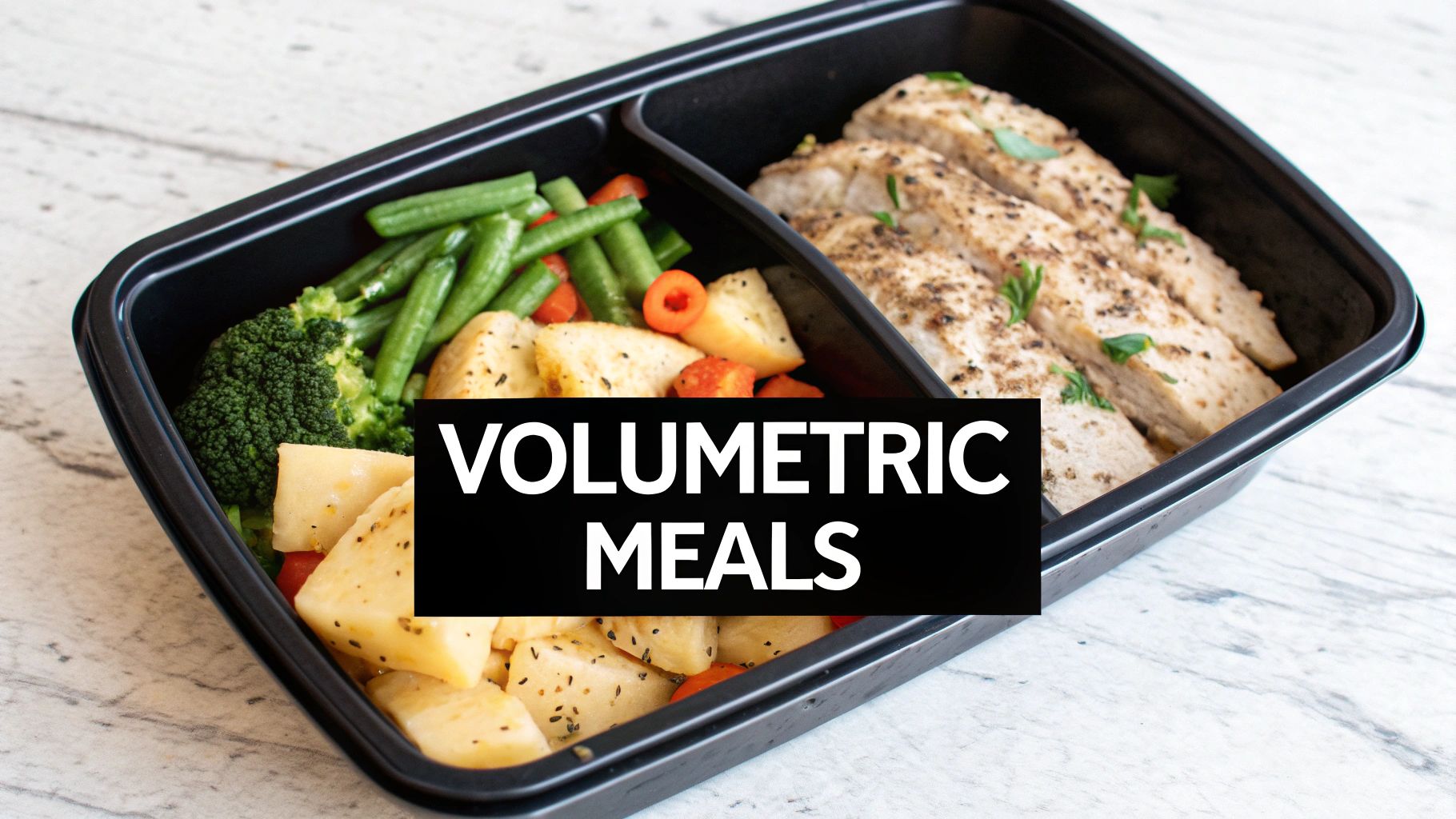
Volumetric eating is a game-changer for anyone who struggles with hunger in a calorie deficit. The approach focuses on maximizing food volume by prioritizing ingredients with low calorie density. The principle is simple: you create large, satisfying meals that are physically filling but contain fewer calories.
This system involves building your plate around high-volume foods like non-starchy vegetables and lean proteins while limiting calorie-dense items like oils and nuts. This allows you to eat a large amount of food (often 1-2 lbs per meal) for just 400-500 calories, which helps your brain and stomach feel full.
How to Build Your Bowl
Follow this high-volume structure to crush hunger:
- Vegetable Base (60-70% of volume): Make this the star of the meal. Aim for huge portions of low-calorie vegetables like roasted broccoli (400g), zucchini noodles (600g), or a massive spinach and cucumber salad.
- Lean Protein (20-30% of volume): Add a lean protein source for satiety, like grilled chicken breast (150g) or white fish (150g).
- Carbohydrates (Optional/Small Portion): If you include carbs, choose nutrient-dense options in controlled portions, like 100g of roasted sweet potato.
- Fats (Minimal): Use fats strategically for flavour, like 1 tsp of olive oil for roasting or ¼ of an avocado.
Actionable Tip
Roast entire sheet pans of broccoli, Brussels sprouts, and bell peppers on Sunday. This gives you a ready-to-go volume base for the week. To avoid getting bored, rotate through 3-4 different vegetable combinations weekly. Use zero-calorie flavour enhancers like hot sauce, salsa, mustard, and vinegar to keep meals interesting.
7. The Flexible Dieting / IIFYM (If It Fits Your Macros) Modular System
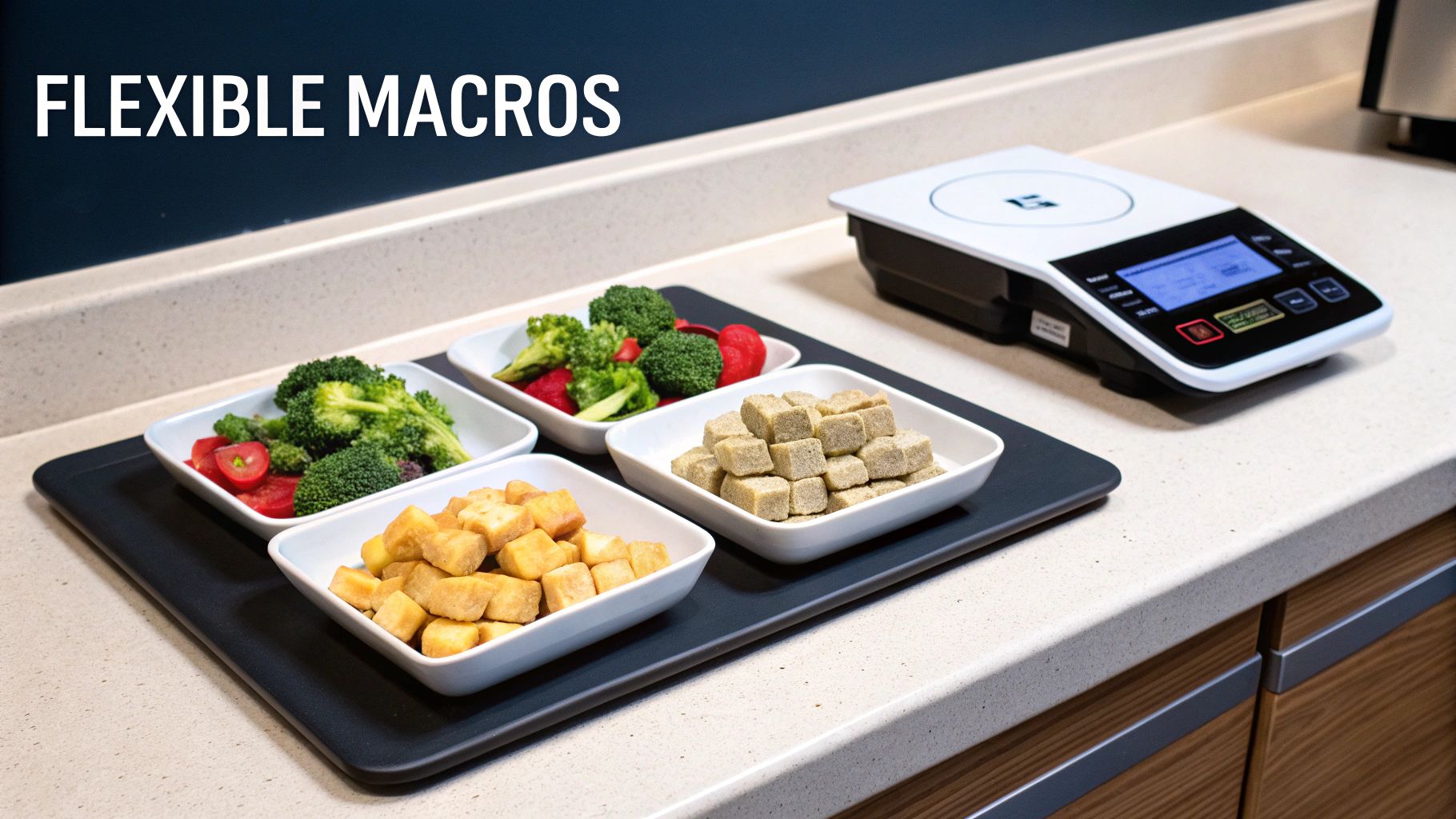
Flexible Dieting, or IIFYM (If It Fits Your Macros), is a system where you treat your daily nutrition like a budget. Instead of restricting specific foods, you focus on hitting daily protein, carbohydrate, and fat goals. By prepping interchangeable "macro blocks," you can build meals that fit your exact numerical targets.
This system is effective because it combines structure with freedom. You create a foundation with prepped whole foods and use a tracking app like MyFitnessPal to hit your targets. This allows you to include foods you enjoy without derailing your progress, as long as they fit within your daily macro budget.
How to Build Your Day
Structure your day by prepping modular food portions and tracking them:
- Protein Blocks: Prep lean protein in versatile portions. For example, 150g of cooked chicken breast (approx. 45g protein).
- Carbohydrate Blocks: Batch-cook complex carbs, like 150g of cooked jasmine rice (approx. 45g carbs).
- Fat Blocks: Have healthy fats ready to add, such as 1 tablespoon of olive oil (approx. 14g fat).
- Meal Assembly: Combine these prepped blocks to build meals that align with your targets. If your lunch goal is 40P/50C/15F, you can combine chicken, rice, and a fat source to get close, then adjust other meals accordingly.
Actionable Tip
Success with IIFYM requires accuracy. For the first few weeks, use a food scale for everything to learn what correct portions look like. To simplify tracking, a recipe nutrition calculator can be a huge help. Aim to get 80-90% of your calories from whole, nutrient-dense foods, leaving 10-20% for flexible items that make the diet more enjoyable and sustainable.
8. The Grocery List Template with Macro-Assigned Foods (Tier System Approach)
For those who find detailed macro tracking tedious, the Tier System is a framework that simplifies portion control. This method organizes foods into three tiers based on their caloric density and nutritional value, creating an intuitive guide for building balanced meals. It automates calorie management without requiring you to weigh every ingredient.
This system is about prioritizing nutrient-dense, low-calorie foods. By building your plate mostly from Tier 1, adding controlled portions from Tier 2, and limiting Tier 3, you naturally create a caloric deficit. This approach focuses on inclusion and mindful portioning rather than strict restriction.
How to Build Your Plate with Tiers
Follow this simple structure to create balanced meals:
- Tier 1 (Unlimited Volume): These are your high-fibre, high-volume foods. Fill at least half your plate with these. Examples include grilled chicken breast, spinach, steamed broccoli, cod, and shrimp.
- Tier 2 (Measured Portions): These are nutrient-dense carbs and healthy fats that require portion control. Think a fist-sized portion of carbs or a thumb-sized portion of fats. Examples include jasmine rice (1 cup cooked), a medium sweet potato, or a quarter of an avocado.
- Tier 3 (Limited and Planned): These are treats or less nutrient-dense foods to enjoy mindfully and infrequently. Plan for one or two per week, like a small square of dark chocolate or a glass of wine.
Actionable Tip
Create your own tier list and post it on the fridge as a daily reminder. When meal prepping, choose 2-3 Tier 1 proteins, several Tier 1 vegetables, and 2 Tier 2 carb and fat sources. This allows you to mix and match all week. For example, grilled salmon (Tier 1) with one cup of quinoa (Tier 2) and unlimited roasted asparagus (Tier 1) creates a perfect meal.
8-Method Meal Prep Comparison for Weight Loss
| Strategy | Implementation Complexity 🔄 | Resource Requirements ⚡ | Expected Outcomes 📊 | Ideal Use Cases 💡 | Key Advantages ⭐ |
|---|---|---|---|---|---|
| The 40/30/30 Macro-Balanced Bowl Template | Low — simple visual portion rules, easy to scale | Low–Moderate — basic kitchen, common proteins/carbs/fats, minimal tracking | Balanced energy, muscle retention, controlled calorie intake | Busy professionals; 8–12 week transformations; works with IF or regular meals | Easy to replicate, reduces decision fatigue, sustainable for long-term use |
| High-Protein Low-Carb Day / High-Carb Training Day Protocol | High — daily macro cycling and multiple meal templates | Moderate–High — separate containers, tracking app, possible coach support | Improved lift performance on training days; accelerated fat loss overall | Clients training 3x/week seeking faster body-composition changes | Optimizes performance and recovery while enhancing fat loss |
| The Protein-First Satiety Model | Moderate — calculate protein target and distribute across meals | Moderate — higher protein cost, may use supplements, require varied protein sources | High satiety, preserves lean mass, supports recomposition | Aggressive fat loss phases, clients prone to hunger or late-night cravings | Maximizes fullness and muscle retention; high adherence reported |
| The Slow‑Carb Intermittent Fasting (SCIF) Meal Prep System | Moderate — schedule eating window and prepare large meals | Low — fewer meals to prep but need slow‑carb staples (legumes, oats) | Reduced meal-prep time, stable blood sugar, natural calorie deficit | Busy clients with limited prep time who tolerate large meals/IF | Time- and cost-efficient; simplifies daily decision-making |
| The Reverse Diet Meal Prep (Progressive Calorie/Macro Increase) | High — weekly incremental changes and frequent monitoring | High — coaching, regular InBody scans, careful tracking | Prevents rebound fat gain, restores hormones, increases training capacity | Post-cut clients, those with yo-yo dieting history, athletes returning to maintenance | Sustainable return to higher calories with preserved body composition |
| The Volumetric Eating Prep System | Moderate — bulk vegetable prep and large‑volume meals | Moderate — lots of fresh produce, storage/freezer space, prep time | Max satiety per calorie, improved fiber/micronutrient intake, sustainable deficit | Clients struggling with hunger; large weight-loss targets (>20 lbs) | High fullness at low calories; simple volume-based adherence |
| The Flexible Dieting / IIFYM Modular System | Moderate–High — learning curve for tracking and portioning | Moderate — food scale, tracking app, some coaching initially | Long-term sustainability, flexible social eating, educated clients | Experienced dieters or clients seeking lifestyle flexibility and maintenance | Very flexible; teaches nutrition skills and supports varied preferences |
| Grocery List Template with Macro‑Assigned Foods (Tier System) | Low — simple tier selection and meal assembly | Low — printable lists, basic groceries, minimal tracking | Consistent calorie control via portioned Tier 2, high adherence for novices | Beginners, clients intimidated by macros, busy professionals | Easiest to teach and follow; reduces decision fatigue while allowing treats |
Your Next Step: From Plan to Plate
You now have eight powerful meal prep ideas for weight loss. The common thread isn't a magic recipe, but the principle of being intentional. Sustainable fat loss comes from deliberately planning your nutrition to support your goals, activity, and lifestyle.
The key is to pick one system and stick with it. The most effective plan is the one you can follow consistently.
Turning Knowledge into Action
Your immediate task is to choose one system from this list that resonates with you.
- Select Your System: Pick the framework that seems most achievable right now.
- Execute Consistently, Not Perfectly: Aim for 80% adherence. If a meal goes off-plan, get back on track with the next one. Progress is the goal, not perfection.
- Assess and Adapt: After two weeks, check in. How do you feel? Are you seeing progress? Is it sustainable? Use this data to either continue or try a different method.
Mastering your nutrition is one of the most powerful things you can do to accelerate your fitness journey. When you eliminate guesswork around food, you free up mental energy to focus on your training, recovery, and overall well-being.
If you're ready to stop navigating this journey alone and want a clear, guaranteed path to your goals, our expert coaches are here to help. OBF Gyms in downtown Toronto specialises in integrating personalized strength training with precision nutrition coaching to deliver measurable results. Let us build your roadmap to success, starting today at OBF Gyms.
Built with Outrank app