

If you want to break through a weight loss plateau, the solution is not more effort—it's a smarter strategy. You need to work with your body's natural adaptation, not against it. In practice, this means making calculated adjustments to your nutrition and giving your training a new, compelling reason to change.
Don't panic. A plateau isn't a failure; it's a predictable milestone in your journey.
Why Your Progress Stalled and What to Do Next
Hitting a weight loss plateau can feel like you've done something wrong, but as a coach, I see it as a sign of success. It means you've been consistent enough to lose a significant amount of weight, and your body has successfully adapted to its new normal. This isn't a setback; it's your body creating a new baseline.
With most clients, we see this happen after they drop their first 15-20 pounds. Your body is an incredibly efficient machine, and from a biological standpoint, it doesn't like losing weight. It sees a prolonged energy deficit as a threat to survival and makes smart adjustments to protect itself.
Your Body's Smart Adaptation
As you get leaner, your body cleverly reduces its daily energy needs through a process called metabolic adaptation. A lighter body simply requires fewer calories to move and function than a heavier one did. Think of it like a car—as it sheds weight, it becomes more fuel-efficient and needs less gas to go the same distance.
This isn't just about weight, though. It's driven by powerful hormonal shifts designed to conserve energy. Key hormones that regulate your metabolism, like adrenaline and thyroid hormone, start to dial back their output. This can reduce your daily calorie burn by as much as 5-10%. In practice, this means the calorie deficit that worked before is no longer a deficit at all.
The most important mindset shift is to stop blaming yourself. A plateau is not a moral failing or a lack of willpower. It's a biological checkpoint, and your job is to respond with a smarter strategy, not just more brute force.
Reframing the Plateau
This adaptation is exactly why the plan that delivered amazing results for the first three months suddenly stops working. It’s not that you're doing anything wrong. It's that the game has changed, and your playbook needs an update.
- Who this affects: Nearly everyone who successfully loses a significant amount of weight. It’s even more noticeable for people who have lost weight quickly or have been in a calorie deficit for an extended period.
- Who this does NOT affect: If you're a true beginner and have only been at it for a few weeks, any stall is almost certainly due to small inconsistencies in your nutrition tracking or training effort, not metabolic adaptation.
Understanding this biological process removes the frustration and allows you to tackle the problem like a coach: logically and systematically. You can learn more about how your metabolism really works by busting some common myths. While you figure out why your progress has paused, exploring the best supplements for weight loss can also offer some extra support.
The goal now is to turn this pause into a calculated next step. Once you accept that your body has adapted, you can make the strategic adjustments needed to get the scale moving again.
Your Plateau-Breaking Diagnostic Checklist
Before you slash calories or add more cardio, you need to play detective. When a client hits a wall, we don’t guess—we assess. This takes the emotion out of it and shines a light on the real reason progress has stalled.
We run every client through a simple but powerful four-pillar framework to find the weak link. You have to be brutally honest with yourself here. The right diagnosis is the only way to find the right solution.
This decision tree shows the exact logic we follow when a client's fat loss seems to have stopped.
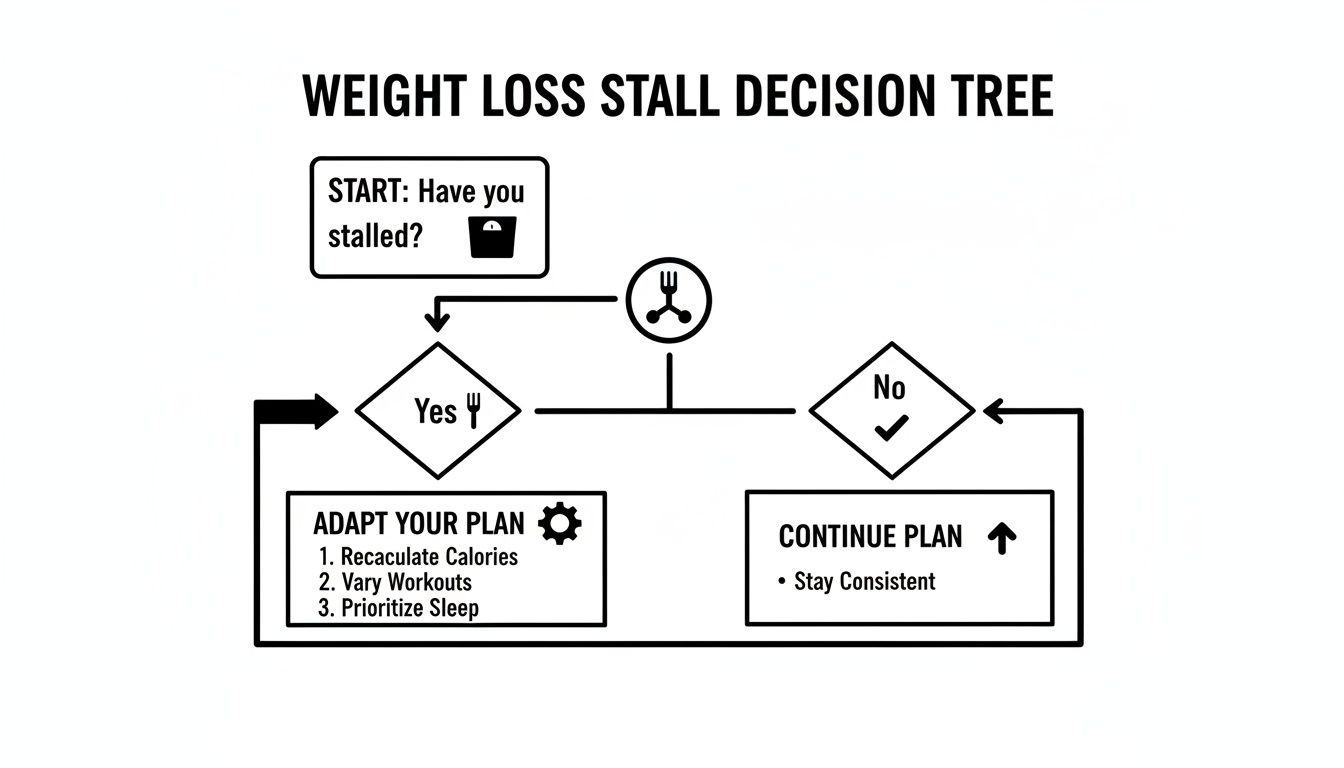
As you can see, a stall isn't a dead end. It’s a signal to gather more data, pinpoint the problem, and make a smart adjustment.
To figure out exactly where to start, use this self-audit checklist. Go through each pillar and give yourself an honest rating from 1 (needs a lot of work) to 5 (perfectly consistent). This will immediately show you what needs fixing.
Plateau Diagnostic Checklist: Is It a Stall or Inconsistency?
| Pillar | High-Adherence Action (Progress) | Low-Adherence Action (Plateau) | Your Rating (1-5) |
|---|---|---|---|
| Nutrition | Weighing and tracking all food/drinks with >90% accuracy; hitting macro targets daily. | "Eyeballing" portions; untracked snacks/oils/drinks; missing daily targets often. | |
| Training | Following a structured plan; actively trying to lift heavier or do more reps each week. | Going through the motions; using the same weights/reps for weeks; skipping workouts. | |
| Recovery | Consistently getting 7-9 hours of quality sleep per night; managing stress effectively. | Sleeping <7 hours; high stress levels; feeling constantly tired or rundown. | |
| Measurements | Tracking weekly average weight, body measurements, and progress photos consistently. | Only using the scale; inconsistent tracking; getting discouraged by daily weight changes. |
Once you’ve filled this out, the pillar with the lowest score is your top priority. Don't try to fix everything at once. Focus your energy on that one area, and you’ll be amazed at how quickly things start moving again.
The Nutrition Adherence Audit
Let’s be direct: the number one reason for a plateau is a slow creep in your nutrition tracking. What starts as perfect logging becomes "eyeballing" pasta, forgetting the oil in the pan, or not tracking that handful of almonds. What we typically see is that after 8-12 weeks, people accidentally add 200-400 calories back into their day without noticing.
- Who this is for: Anyone who isn't weighing and tracking their food with at least 90% consistency.
- Who this is NOT for: People who are already obsessively adherent. If that's you, your problem lies elsewhere.
Your action step is simple: commit to one full week of strict food logging. Weigh everything. Track everything. No excuses. Think of it as a short-term data collection project to see what’s really going on.
Training Intensity and Progression
Your body is incredibly efficient. That workout that felt impossible six weeks ago? It’s now your new normal. If you aren't actively giving your body a reason to change, it won't.
Ask yourself: Are you just going through the motions, or are you chasing progressive overload? This simply means you’re systematically making your workouts harder over time. This can mean:
- Adding more weight: Even a 2.5 lb increase is progress.
- Doing more reps: Getting 9 reps this week when you only got 8 last week with the same weight.
- Improving your form: Using a fuller range of motion or better control.
If your training log looks identical to last month's, we've found the problem.
Recovery and Stress Management
This is the pillar everyone ignores until it brings their progress to a screeching halt. You don’t build a better body in the gym; you build it when you rest. High cortisol from chronic stress makes your body hold onto water, which can easily hide fat loss on the scale. And if you’re consistently getting less than 7 hours of quality sleep, you're sabotaging the very hormones that control appetite and metabolism. For many clients, simply fixing their sleep is enough to break a plateau.
Measurement Accuracy
Finally, you need to be sure you’re even in a plateau. The scale only tells a tiny part of the story; it fluctuates daily due to water, salt, and carbs. Relying on it alone will drive you crazy.
A smart approach to tracking is critical. We teach our clients how bi-weekly assessments can provide a clearer picture of their progress by using multiple data points to see the real trend. Your self-audit must include:
- Weekly average weigh-ins: Weigh yourself daily, but only care about the weekly average. This smooths out the noise.
- Body measurements: Use a tape measure for your waist, hips, and chest every 2-4 weeks. If your waist is shrinking, you're losing fat.
- Progress photos: Take them every four weeks—front, side, and back—in the same spot with the same lighting. The mirror shows changes before the scale does.
- Gym performance: Are you getting stronger? This is a direct sign that you’re preserving or building muscle.
If three of these four metrics are moving in the right direction, you are not in a plateau. You're just experiencing a normal dip. Trust the process and stay consistent.
Recalibrating Your Nutrition for Continued Fat Loss
When the scale stops moving, vague advice like “just eat a little less” is useless. After you’ve lost weight, your body is a fundamentally different machine. It’s lighter, more efficient, and requires less fuel. The nutritional plan that got you here won’t get you to the next stage. It’s time for a strategic adjustment.
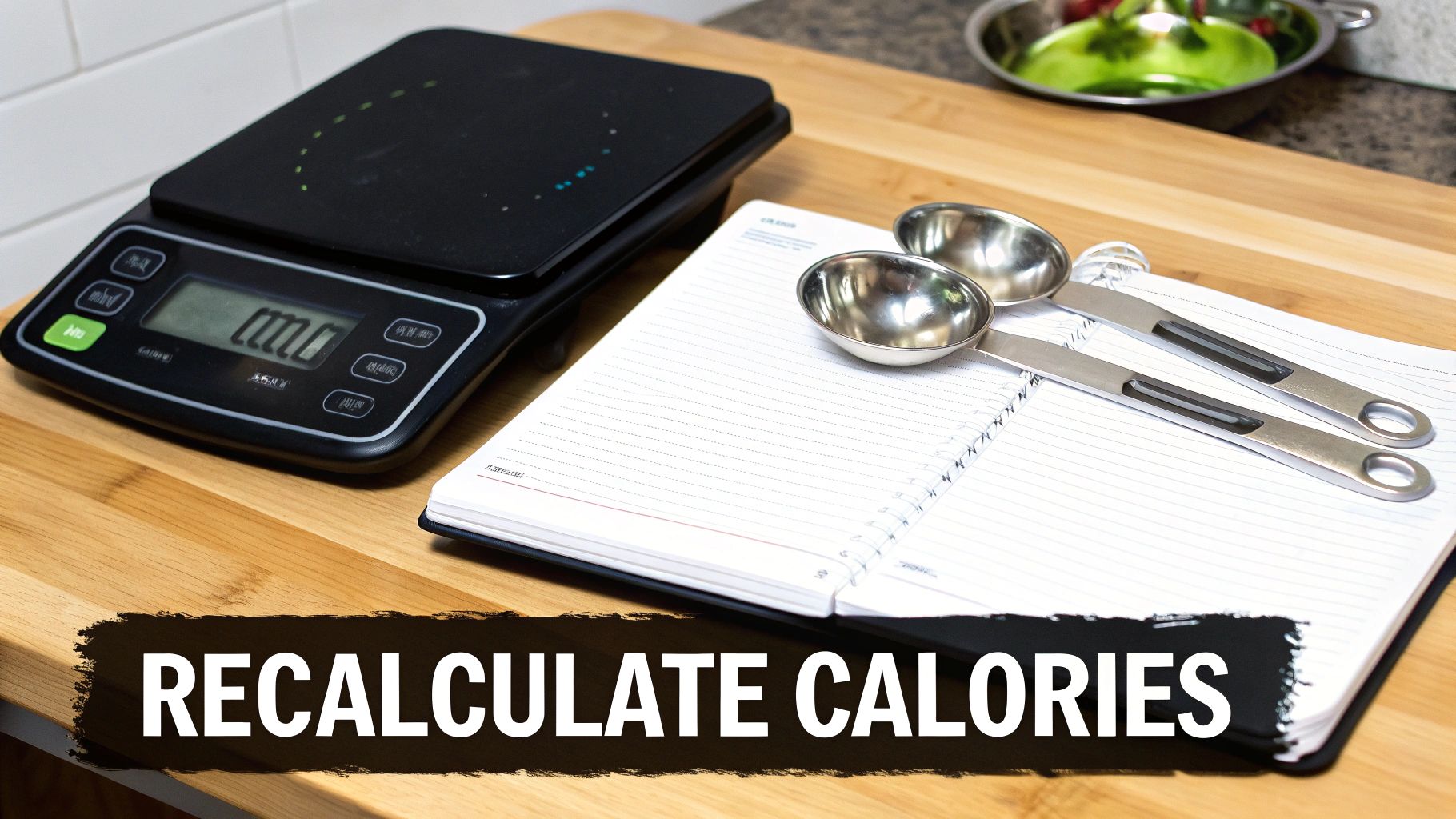
The single most effective action you can take is to recalculate your calorie and macronutrient targets for your new body weight. This isn't a punishment; it’s a necessary update based on your success.
Resetting Your Calorie and Protein Targets
Your first move is to establish a new, appropriate calorie deficit. A lighter body doesn’t burn as many calories, and we need to account for this to get things moving again.
With most clients, we aim for a sustainable deficit of 20-25% below their new maintenance calories. This is the sweet spot: aggressive enough to stimulate fat loss but manageable enough that you can still train hard and preserve muscle. Dipping lower often backfires, leading to burnout and muscle loss.
Alongside this calorie adjustment, we lock in a non-negotiable protein target.
- Protein Goal: Aim for 1.6 to 2.2 grams of protein per kilogram of your current body weight.
Hitting this protein goal is critical. It protects muscle while you're in a deficit, which keeps your metabolism firing. It also has a huge impact on satiety, making it far easier to stick to your lower calorie budget. If you want a deeper dive, you can learn more about the difference between calories vs. macros in our detailed guide.
Advanced Tools: Diet Breaks and Refeed Days
Let's say a client has nailed their new calorie targets with perfect consistency for weeks, and progress still remains stalled. Only then do we introduce advanced strategies like diet breaks or refeed days. These are not first-line defenses; they are tactical tools for specific situations.
A diet break is a planned, one-to-two-week period where you bring calories back up to your new maintenance level. A refeed day is a single, high-carbohydrate day worked into your deficit week, also bringing calories up to maintenance for that day.
The goal for both is a physiological and psychological reset. These planned periods can help boost hormones like leptin (which regulates hunger) and reduce the cumulative stress of dieting, making it easier to return to your deficit with renewed focus.
Who Should Use Refeeds and Who Should Not
These are powerful tools, but they are frequently misused. They are not cheat days. They must be planned and executed with the same precision as your deficit days.
This strategy works best for:
- Highly Adherent Individuals: Clients who have been tracking meticulously for months and are already quite lean (e.g., under 15% body fat for men, under 25% for women).
- Hard-Training Athletes: People pushing performance who feel the fatigue and stalled lifts that come with a long-term deficit.
- The Psychologically Fatigued: Individuals who feel burnt out from the grind of dieting and need a structured mental break to improve long-term adherence.
This strategy does NOT work for:
- Beginners or Inconsistent Trackers: If you haven’t mastered the fundamentals, a refeed will only cause confusion and set you back.
- Those with a History of Binge Eating: The structure of a refeed can sometimes trigger binge-restrict cycles.
- Anyone Whose Adherence is Below 90%: If your plateau is due to inconsistency, adding complexity is the wrong move. Master the basics first.
In practice, we rarely introduce refeeds until a client has been in a consistent deficit for at least 8-12 weeks and shows clear signs of diet fatigue. Choosing the right tool for the right person at the right time is what separates professional coaching from guesswork.
Your Next Step: Recalculate your maintenance calories for your current weight. Set a new daily target that reflects a 20-25% deficit and lock in your protein goal. Commit to hitting these new numbers with 90%+ accuracy for two weeks before considering any other changes.
Upgrading Your Workouts to Force New Results
If your body has adapted to your diet, you can bet it has also adapted to your workouts. That training session that felt tough two months ago is now just maintenance. To break a plateau, you need to give your body a new, compelling reason to change. Stalling isn't a sign to do more random exercise; it’s a signal to train smarter.
This means getting serious about the single most important training principle: progressive overload. It’s a simple concept that means systematically making your workouts more challenging over time. Without it, you’re just spinning your wheels.
What Progression Actually Looks Like
"Get stronger" is too vague. In practice, we make progress concrete and measurable because your body responds to specific demands, not general intentions.
Let's map out a real four-week progression for a back squat. Let's say a client's current best is 135 lbs for 3 sets of 8 reps. Here’s how we'd structure their next month to force new results:
- Week 1 Goal (Volume): Perform 3 sets of 9 reps at 135 lbs. We demand one extra rep from each set.
- Week 2 Goal (Load): Perform 3 sets of 8 reps at 140 lbs. Volume drops, but intensity is higher.
- Week 3 Goal (Consolidation): Perform 3 sets of 9 reps at 140 lbs. We're matching the rep count from Week 1 but with heavier weight.
- Week 4 Goal (Peak): Attempt 3 sets of 8 reps at 145 lbs. This sets a new personal record and a new baseline for the next training block.
This methodical approach leaves nothing to chance. Each week has a clear target that builds on the last. This is how you systematically build muscle and increase your metabolic rate—both critical for smashing a plateau.
When to Change Your Training Style
Progressive overload isn't always about adding five pounds to the bar. Sometimes, a bigger change is needed to create a new stimulus. We typically see two scenarios where a program overhaul is the right move.
Shifting from Volume to Strength: A client might have spent 12 weeks in a "hypertrophy" phase (10-15 reps). If they stall, we might shift them into a four-week "strength" block (4-6 reps) with much heavier weight. This shocks the nervous system in a new way and builds raw strength they can use when they return to a volume phase.
Introducing New Exercises: If a client has been doing the same core lifts for six months, their body becomes efficient at those movements. Swapping a barbell back squat for a front squat, or a conventional deadlift for a Romanian deadlift, can present a new challenge that sparks new adaptations.
Coaching Insight: A simple rule we use is this: if an intermediate is still progressing on their main lifts, a small adjustment like adding weight or reps is all they need. If an advanced client has truly stalled across all metrics for over a month, it's time for a program overhaul. Don't change everything if a small, targeted tweak will do the job.
Why HIIT Is a Better Tool Than Endless Cardio
When the scale gets stuck, the first instinct for many is to add an hour of jogging. This is almost always the wrong move. Long, slow cardio can increase cortisol, which encourages water retention and can even lead to muscle breakdown when you're in a calorie deficit.
Instead, we use short, intense High-Intensity Interval Training (HIIT) sessions two or three times a week. A session might look like this:
- Airdyne Bike Sprints: 20 seconds of all-out effort, followed by 40 seconds of slow recovery.
- Repeat: 10-15 rounds.
- Total Time: 10-15 minutes.
This approach is far more effective for fat loss. It creates a massive metabolic disturbance, leading to a higher calorie burn for hours after the workout is over (a phenomenon known as EPOC). Most importantly, it's efficient and helps preserve the muscle you’ve worked so hard to build. For more ideas on how to make your time in the gym count, check out our training tips to maximize your workouts.
Your Next Step: Look at your training log from the last four weeks. If the weights, reps, and sets are all the same, your mission is clear. Pick one key compound lift and create a four-week plan to progressively overload it.
Managing the Hidden Factors: Sleep, Stress, and Recovery
Nutrition and training are the pillars you can see, but sleep, stress, and recovery are the invisible foundation. These are often the real culprits behind a good plan failing to deliver results. I can't count how many clients have come to us with a flawless food log and a tough training schedule, yet their progress is completely stalled. Nine times out of ten, the bottleneck is stress and poor sleep.
This isn't a mindset issue; it's pure physiology. Chronic stress floods your body with the hormone cortisol. When cortisol is constantly elevated, it directly sabotages fat loss: it tells your body to hold onto water and it cranks up cravings for high-calorie foods. This means you could be losing fat, but the scale won't budge because you’re retaining water, making you feel puffy and discouraged.

When figuring out how to overcome a weight loss plateau, managing these hidden factors is non-negotiable. Your body doesn't know the difference between stress from a work deadline and stress from a workout—it’s all just stress. Without proper recovery, you never give your body the chance to adapt and improve.
Actionable Strategies Beyond "Get More Sleep"
Vague advice like “manage your stress” is useless. Instead, we give our clients specific protocols. Your body thrives on routine, so building a consistent wind-down habit is one of the most powerful changes you can make.
- Implement a "Digital Sunset": Shut down all screens—phone, TV, laptop—at least 60 minutes before sleep. The blue light messes with melatonin production, the hormone that signals your body it's time to wind down.
- Standardize Your Wake-Up Time: This is a game-changer. Even on weekends, wake up within the same 60-minute window. This stabilizes your circadian rhythm, which improves sleep quality and regulates the hormones controlling appetite.
- Create a Pre-Sleep Ritual: Spend 15-20 minutes doing something calming: light stretching, reading a physical book, or meditating. It’s a clear signal to your brain and body that the day is over.
I had a client who was doing everything right—hitting his protein, crushing his workouts—but his weight hadn't budged in a month. He was consistently sleeping only five hours a night. We made one change: for seven days, his only goal was to be in bed for eight hours. The result? He dropped four pounds. No changes to his diet or training. His body finally let go of all the stress-induced water retention.
Who Needs to Prioritize This and Who Doesn't
Understanding recovery is essential, but how much you need to focus on it depends on where you are in your journey.
This is a top priority for:
- High-Stress Professionals: If your job is demanding, your cortisol is likely chronically elevated. You cannot out-train a high-stress life without dedicated recovery.
- Parents of Young Children: Interrupted sleep is a massive physiological stressor. Prioritizing whatever quality sleep you can get is crucial.
- Anyone Training Intensely 4+ Days a Week: Hard training is a major stressor. If you're not matching that intensity with an equal dedication to recovery, you're just digging yourself into a deeper hole.
This is less of a direct bottleneck for:
- Beginners Training 2-3 Times a Week: When you're just starting out, the new stimulus from training and nutrition will drive progress, even if your sleep isn't perfect yet.
- Individuals with Naturally Low-Stress Lifestyles: If you generally sleep well and manage stress effectively, a plateau is more likely due to a lapse in nutrition tracking or training intensity.
The Takeaway: Your body repairs muscle, balances hormones, and burns fat most effectively while you are sleeping. Treating recovery as optional is the fastest way to hit a wall. Addressing underlying stress and anxiety is crucial for quality sleep and overall well-being. Learn more about regulating stress and anxiety for better sleep.
For an even deeper understanding, read our guide explaining why you can't out-train bad sleep.
Your Next Step: For the next seven days, track your sleep duration with the same diligence you track your calories. Aim for a consistent 7-8 hours per night and implement a digital sunset. This single habit can be the key that unlocks your progress.
Answering Your Plateau Questions
When progress hits a wall, it’s easy for questions and self-doubt to creep in. I've coached hundreds of clients through this exact frustration, so I’ve heard just about every concern. Let's cut through the noise with direct answers grounded in data, patience, and strategic action.
How Long Before I Know It's a Real Plateau?
Let’s be clear: we don't even use the word "plateau" until progress has been stagnant for at least three to four consecutive weeks, assuming you've been sticking to your plan.
Daily weight fluctuations are just noise—your body responding to shifts in water, sodium, and digestion. A single week of no change on the scale means absolutely nothing. It's one data point, not a trend.
We only call it a stall after a full month of no downward movement across all key metrics: your weekly average weight, key body measurements like your waist, and progress photos. Reacting any sooner is a classic mistake that leads to panicked, unsustainable changes.
Is It Possible I'm Gaining Muscle and Losing Fat?
This phenomenon, known as body recomposition, is very real, but who it applies to is extremely important.
This is likely happening if you are:
- A true beginner in your first three to six months of structured strength training. Your body is so responsive to this new challenge that it can build muscle and burn fat simultaneously. The scale might not move, but your clothes will feel looser.
This is NOT what's happening if you are:
- Anyone past the novice stage. Once you’ve built a training foundation, the rate of muscle gain slows dramatically. It becomes far too slow to cancel out a weekly fat loss of 0.5-1.0 lbs. If you're an intermediate and the scale is stuck, you aren't gaining muscle fast enough to hide a true fat loss stall.
This is precisely why we track more than just the scale. If your waist is getting smaller and your lifts are going up, you're making fantastic progress. But if your measurements, photos, and gym performance are all stuck along with your weight, it's a plateau—not muscle gain masking the problem.
You cannot manage what you do not measure. Relying only on the scale is like trying to navigate with a broken compass. You need a complete dashboard—measurements, photos, and performance—to see the true picture.
When Is It Time to Hire a Professional Coach?
It's time to bring in a coach when you've honestly worked through the checklist in this guide and still feel completely stuck. A good coach brings two critical things to the table you can never give yourself: total objectivity and accountability.
We can look at your food and training logs without your emotional baggage. We are trained to spot subtle patterns you’re too close to see, like the slow creep of "eyeballed" portions or a drop in training intensity you haven’t noticed.
If you’ve been truly consistent for over a month, you've tried the strategies outlined here, and nothing is changing, investing in an expert is the most logical next step. It can save you months of spinning your wheels and put you on the fastest path to breaking through for good.
Your Final Takeaway: A plateau is a data problem, not a character flaw. Stop guessing and start assessing. Be patient, trust the process, and when in doubt, get back to mastering the fundamentals of consistent nutrition, progressive training, and dedicated recovery.
At OBF Gyms, we specialize in turning plateaus into progress. Our downtown Toronto personal training programs are built on science-based assessments and customized coaching to deliver measurable results. If you're ready to stop the guesswork and start seeing the changes you deserve, learn more about our proven methods at https://www.obfgyms.com.